
Before most investors buy their first rental property, they try to treat the purchase like buying a house to live in. It seems logical, since the paperwork looks similar on the surface.
Thank you for reading this post, don't forget to subscribe!But financing, contingencies, and even the offer strategy work differently when the property will produce income instead of shelter you personally.
That mismatch is why deals fall apart during financing or during inspection negotiations. Buying an investment property in Denver becomes far more predictable once you understand each stage in the correct order, from setting your goals to closing on a property that actually performs.
This guide walks through what happens at every step and where a knowledgeable local agent changes the outcome.
An investment property purchase in Denver follows a clear sequence: define your strategy, secure investor-specific financing, evaluate the real numbers, then negotiate and close with contingencies built for income property.
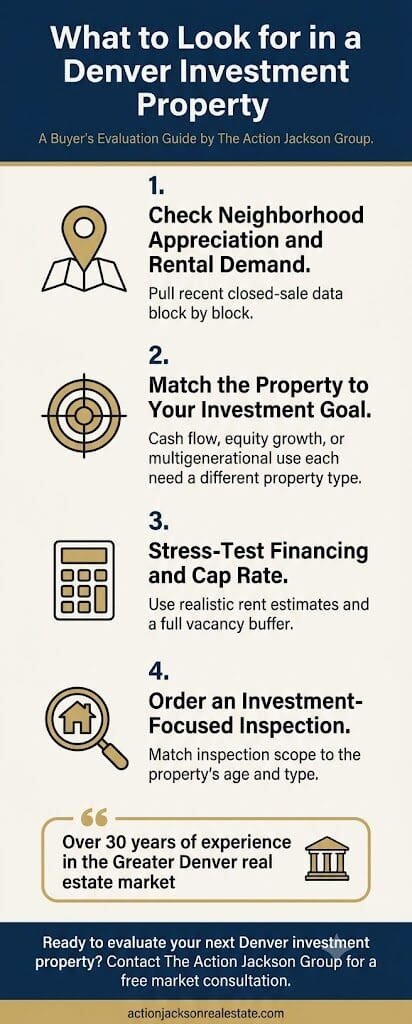
What You Need Before You Start Buying an Investment Property
Before you make an offer, you need clear investment goals, a realistic budget beyond the purchase price, and a credit profile suited to investment financing.
Financial and Goal Requirements Before You Begin
Lenders evaluate an investment purchase more strictly than owner-occupied homes, so a licensed real estate agent in Colorado will typically ask about your goals before discussing properties.
You need clarity on whether you want monthly cash flow, long-term appreciation, or both, since that choice shapes the property type, location, and financing structure you pursue.
Set a total budget that includes the down payment, closing costs, reserves for vacancy, and a repair contingency, not just the purchase price. Check your credit profile early, since investment loans often require a higher score and a larger down payment than a primary residence loan.
Steps Involved in Buying an Investment Property in Denver
Buying an investment property in Denver moves through four stages: setting your strategy, securing financing built for investors, evaluating real numbers on properties, and closing with contingencies suited to income property.
The steps involved in buying an investment property include defining your strategy, getting pre-approved for investor-specific financing, evaluating potential properties against real cash flow numbers, and closing with contingencies that protect you against issues unique to rental property.
Each stage builds on the one before it, so skipping ahead to property search before financing is confirmed often costs investors their strongest offers.
Step 1: Define Your Investment Strategy and Goals
Start by deciding what kind of investor you want to be. A buy-and-hold rental produces monthly income, while a fix-and-flip targets a faster resale profit, and each strategy points toward different neighborhoods and property conditions.
Decide on your target return, your risk tolerance, and how hands-on you want to be with tenants or renovations. Write your goals down before you look at a single listing, so a listing’s appeal does not pull you away from the numbers that matter.
Step 2: Get Pre-Approved for Investor-Specific Financing
Investment property loans carry different requirements than a mortgage for your own home. Lenders typically expect a larger down payment, often 15 to 25 percent, and they weight your credit score and cash reserves more heavily.
Get pre-approved before you start touring properties, since sellers in a competitive Denver market often will not negotiate seriously with an unqualified buyer.
Ask your lender about portfolio loans, DSCR loans based on the property’s rental income, or conventional investment financing, since the right product depends on your strategy from Step 1.
Step 3: Search, Evaluate, and Run the Numbers on Properties
Once financing is confirmed, shift your search toward properties that match your strategy rather than your personal taste.
Calculate the cap rate, cash-on-cash return, and monthly cash flow for every serious candidate, factoring in property taxes, insurance, vacancy, and maintenance reserves, not just the mortgage payment.
“Denver’s investment property market cooled through the summer of 2026, with closed sales falling nearly 19% from July, which gives buyers more room to negotiate than earlier in the year, according to the Denver Metro Association of Realtors’s August 2026 Market Trends Report.”
Step 4: Make an Offer, Handle Contingencies, and Close
When you make an offer on an investment property, build in an inspection contingency that addresses income-producing concerns, such as existing lease terms, tenant estoppel certificates, and the condition of major systems that affect ongoing repair costs.
Appraisers value investment properties partly on comparable rents, not just comparable sales, so a low appraisal can happen even when the sale comparables look strong.
Negotiate repair credits or price adjustments based on the findings, then confirm your lender has cleared final underwriting conditions before scheduling closing.
When Buying an Investment Property Becomes a Job for a Professional
Complex financing, contingency negotiations, and unfamiliar Denver neighborhoods are the points where an experienced investment-focused agent protects your return.
Signs You Need an Experienced Investment-Focused Agent
You likely need professional representation when you are unfamiliar with rent comparables in a target Denver neighborhood, when a lender requires documentation you have not prepared before, or when a seller’s counteroffer includes terms you cannot evaluate on your own.
“Every real estate license holder in Colorado must follow Colorado Division of Real Estate regulations on every transaction, which protects both buyer and seller.”
“Nationally, real estate agents were involved in 88 percent of home purchases in 2025, most often for negotiation and paperwork guidance, according to NAR’s 2025 Profile of Home Buyers and Sellers.”
How The Action Jackson Group Approaches Investment Property Solutions
The Action Jackson Group brings over 30 years of experience in the Greater Denver, Colorado, real estate market to every investment property transaction.
That experience supports clients through finding high-value properties with strong appreciation potential, securing financing suited to their strategy, and negotiating the specific deal terms that affect long-term returns.
The Action Jackson Group also supports multigenerational home searches and helps investors build equity through profitable projects and unfinished spaces, keeping every recommendation tied to your stated goals rather than a generic pitch.
Frequently Asked Questions About Buying an Investment Property
These answers cover the financing, timeline, and budget questions Denver investors ask most often before making an offer.
Q1. How much down payment does an investment property require in Denver?
Most lenders require between 15 percent and 25 percent down for an investment property, compared to as little as 3 to 5 percent for a primary residence. The exact amount depends on the loan type, credit score, and whether the property has one unit or multiple units.
Confirm the down payment requirement for the specific loan product before making an offer.
Q2. What credit score does an investment property loan require?
Most investment property loans require a credit score of at least 620, though many lenders prefer 700 or higher for the best rates. A stronger score can also reduce the required down payment or interest rate. Check the credit report for errors well before applying for pre-approval.
Q3. Can rental income count toward loan qualification for an investment property?
Yes, many lenders count a portion of the property’s projected rental income toward qualifying income, often through a DSCR loan or an appraiser’s rent schedule. The exact percentage counted varies by lender and loan program. Confirm this detail with the lender before assuming a property fits the budget.
Q4. How long does it take to close on an investment property in Denver?
Closing on an investment property in Denver typically takes 30 to 45 days from an accepted offer, depending on the lender, the appraisal timeline, and whether the property has existing tenants.
Properties with complex lease situations or required repairs can take longer. Building extra time into the contract for financing and inspection contingencies protects against a rushed closing.
Q5. What is the biggest mistake first-time investment property buyers make?
The most common mistake is skipping investor-specific financing pre-approval and assuming a primary-residence pre-approval applies the same way. This mistake often surfaces during underwriting, when the loan officer discovers the property does not qualify for the assumed loan product.
Confirming the exact loan type and down payment requirement before searching for properties prevents this delay.
The Bottom Line
Buying an investment property becomes far more predictable when you follow the sequence outlined above: set your strategy, secure financing built for investors, evaluate real numbers, and close with contingencies suited to income property.
Denver’s shifting market conditions make experienced guidance more valuable, not less, since accurate numbers and strong negotiation protect your return long after closing day.
If you are ready to move from research to action, schedule your free investment property consultation with The Action Jackson Group and get guidance built on more than 30 years in the Greater Denver, Colorado, real estate market.